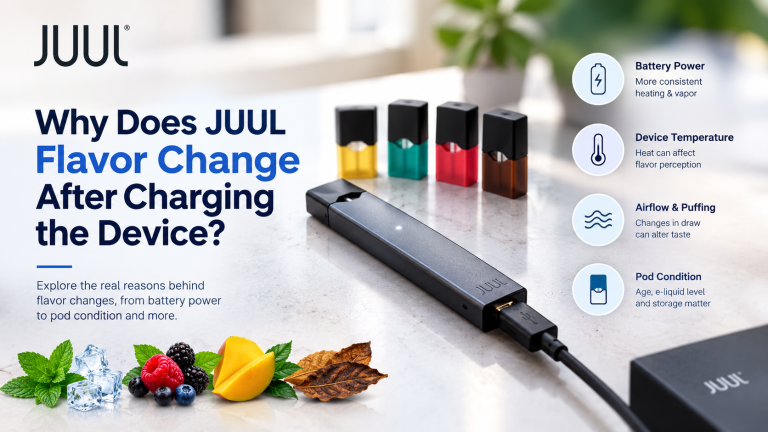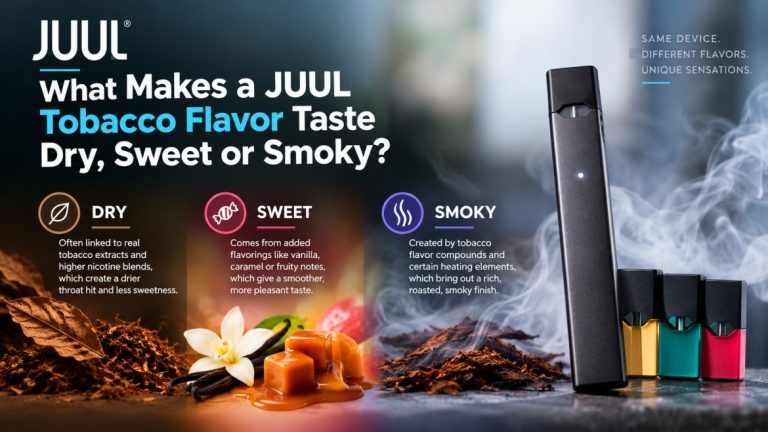
Why Does JUUL Pod Flavor Become Muted Before the Pod Is Empty?

On this page11 sections
- What “Muted JUUL Flavor” Actually Means
- Why JUUL Pod Flavor Can Fade Before the Pod Is Empty
- How Your Puffing Habits Affect Flavor
- Airflow, Temperature, and the UAE Vaping Environment
- Pod Age, Storage, and Why Freshness Matters
- When the Pod Is Fine and Your Perception Has Shifted
- Signs the Pod May Actually Be Near the End of Its Useful Life
- Simple Checks Before Replacing the Pod
- Flavor Longevity Ranking Table (Popular JUUL Flavors in UAE)
- Frequently Asked Questions
- Conclusion
You take a draw from your JUUL, the pod still has liquid in it, and the flavor feels flat. Not burnt, not completely gone just noticeably weaker than it was when the pod was fresh. This happens with every flavor in the lineup, from Classic Menthol 5% to Mango 18MG to Virginia Tobacco 5%. The pod is not empty, the device seems fine, but the taste has gone quiet.
Before switching to a new pod or assuming the one you have is defective, it is worth understanding what is actually happening. JUUL pod flavor becoming muted before the pod is empty is almost always explainable. The cause usually comes down to how the wicking system behaves as liquid decreases, what repeated heating cycles do over time, how UAE temperatures affect pod performance, and how human taste perception naturally shifts with prolonged exposure to the same flavor. This guide covers all of them.
What “Muted JUUL Flavor” Actually Means
Distinguishing Weak Flavor from Other Pod Problems
Muted flavor is a specific experience worth naming precisely before diagnosing. The pod still draws. Vapor is still produced. The taste is just quieter, flatter, and less distinct than it was on the first day. That is muted flavor. It is not the same as a burnt hit, which has a harsh, scorched quality. It is not the same as reduced vapor output, which is a separate issue. And it is not the same as a complete absence of taste, which usually signals the pod is genuinely finished. Each of these experiences points in a different direction, and lumping them together leads to the wrong fix.
Why Visible Liquid Does Not Tell the Whole Story
Most users assume that if liquid is still visible in the pod window, the pod should be performing at its original level. That assumption is reasonable but incorrect. A JUUL pod delivers flavor through a combination of liquid, a wick, and a heating element working together. When any one of those three factors changes and they all change as the pod is used the flavor output changes with them, even when liquid remains. Visible liquid, vapor production, and flavor strength are three different things. None of them alone gives you the full picture.
| What You Experience | What It May Point To |
|---|---|
| Flavor present but noticeably weaker | Pod age, wicking behavior, flavor adaptation, storage conditions |
| Dry, less satisfying sensation | Reduced liquid reaching the coil; pod nearing end of life |
| Harsh or scorched taste | Wick running dry, chain vaping, pod near depletion |
| Less visible vapor | Battery level, blocked airflow, or reduced liquid output |
| Inconsistent flavor between draws | Uneven liquid distribution, condensation buildup, airflow restriction |
Why JUUL Pod Flavor Can Fade Before the Pod Is Empty
The Wicking System Changes as Liquid Decreases
A JUUL pod works through a wick that draws e-liquid from the reservoir to the heating element. When the pod is full, the wick is completely saturated and the heating element receives a consistent supply of liquid with every draw. As the pod is used and the liquid level drops, the wick has less material to draw from. The supply becomes less consistent. Some draws may wick correctly; others receive slightly less liquid, producing thinner flavor even though the pod technically still has content. This is not a defect. It is how the wicking system behaves as reservoir volume decreases.
This is especially noticeable with lighter fruity options like Mango 18MG and Berry 18MG, where delicate flavor compounds are often the first to thin out as the pod ages. Heavier profiles like Virginia Tobacco 5% and Classic Menthol 5% tend to hold up slightly better in the later stages because the core flavor notes are more robust by nature.
What Repeated Heating Does Over the Life of a Pod
Every draw fires the heating element, which vaporizes a small amount of e-liquid. Over the life of a pod up to 200 puffs the cumulative effect of those heating cycles on the remaining liquid is gradual but real. The flavor compounds in e-liquid are not all identical in how they respond to heat. Some vaporize earlier in the pod’s life. By the time you are in the final quarter, the flavor profile of the remaining liquid is a reduced version of the original blend, not a complete replica.
This explains why a pod in its final stretch can taste noticeably different from the same flavor when it was fresh even before you can visually confirm it is running low. The JUUL flavor fade guide on podsvibe.ae covers this in detail alongside clear signals for when to replace.
Liquid Level, Vapor Output, and Flavor Are Three Separate Things
This distinction matters more than most users realize. A pod can still produce sufficient aerosol while delivering very little taste particularly when the remaining liquid is low in flavor compounds due to repeated heating. Similarly, a pod can show liquid in the window while the wick’s saturation has already become inconsistent. Relying on any one of these three indicators alone leads to keeping a pod in rotation long past the point where it is actually serving you well.
How Your Puffing Habits Affect Flavor
Chain Vaping and What It Does to the Wick
Taking several draws back to back is one of the most common ways to make flavor seem weaker before the pod is actually depleted. Each draw requires the wick to re-saturate before the next pull, and rapid puffing does not give it enough time. The result is pulls that draw from a partially dry wick, producing thinner flavor not because the pod is empty but because the system has not recovered between uses. Users who chain vape regularly will notice this effect much earlier in a pod’s life than those who space their draws out. The guide to JUUL flavors for chain vapers goes into which profiles handle this usage pattern better than others.
Draw Length, Session Frequency, and Pod Lifespan
Longer draws put more demand on the wick in a single pull than the system handles optimally. Taking slow, extended draws tends to thin out the flavor at the tail end of each pull, and over repeated sessions this accelerates the overall rate at which flavor output declines. Shorter, steadier draws with a few seconds between each one consistently produce better-flavored vapor across the pod’s lifespan. If you want to extend how long a pod stays flavorful, the guide to maximizing JUUL pod juice and longevity has practical steps that make a real difference in daily use.
Why Two People Experience the Same Pod Differently
Two users on the same flavor, same nicotine strength, and same batch of pods can have completely different views on when that pod feels finished. Puffing frequency, draw length, intervals between sessions, and individual flavor sensitivity all play a role. One person considers a pod done when flavor drops to 70% of its original quality; another comfortably uses the same pod to near-depletion. Neither is wrong. It reflects how personal the interaction between usage habits and pod performance actually is.
Airflow, Temperature, and the UAE Vaping Environment
How Blocked Airflow Makes Flavor Seem Muted
Airflow through the mouthpiece plays a significant role in how flavor is perceived. When it is partially blocked by condensation, debris, or how the device is being held, the vapor reaching the palate is more constricted than it should be. This can make an otherwise normal pod feel like it is producing almost no flavor at all. A quick inspection of the mouthpiece area and a wipe to clear any condensation or residue often restores a noticeably cleaner draw without any need to replace the pod.
If the problem goes deeper, the guide to fixing a weak JUUL hit walks through airflow, seal, and pod checks specific to UAE users.
Temperature and Pod Storage in UAE Conditions
This is where UAE conditions become directly relevant. High ambient temperatures affect how e-liquid behaves inside a pod. Leaving a device in a car during summer in Dubai or Abu Dhabi, keeping pods in a bag left in direct sunlight, or storing them near windows in flats that heat up before the air conditioning catches up all of these conditions can alter e-liquid viscosity and degrade flavor compounds before the pod has been properly used. The dedicated guide on how temperature affects JUUL pod flavor and nicotine delivery covers the specifics of what happens at different heat levels.
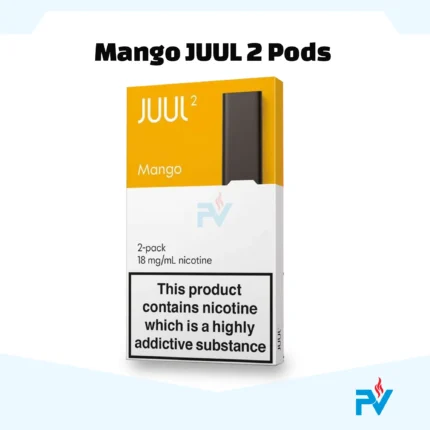
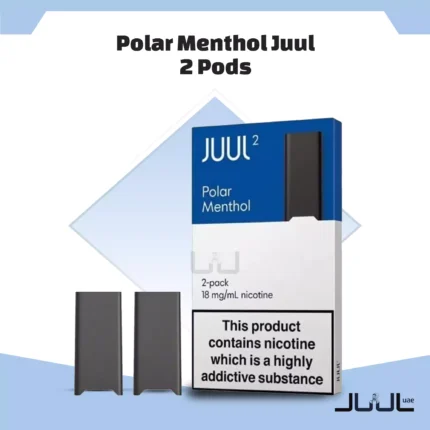
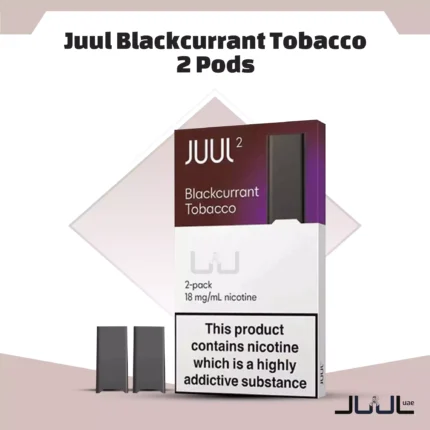
Lighter, fruitier flavors are more vulnerable here. Mango JUUL 2 Pods and Watermelon JUUL 2 Pods lose freshness faster under heat exposure than heavier profiles like Blackcurrant Tobacco JUUL 2 Pods or Polar Menthol JUUL 2 Pods. Keeping spare pods in a cool, stable indoor environment away from direct sunlight is the most effective way to protect flavor quality, especially when buying in bulk.
Pod Age, Storage, and Why Freshness Matters
Why an Older Pod Can Lose Flavor Before It Is Empty
A pod that has been in active use for four or five days is an older pod, particularly in UAE conditions. Even with liquid remaining, its flavor quality reflects the cumulative time in use. Ambient air enters through the mouthpiece with every draw, and over multiple days this exposure gradually affects the e-liquid. A pod used across two days will generally taste better toward its end than the same pod stretched across a week in Dubai summer heat. This is not a quality issue; it is how e-liquid chemistry responds to time and environment. The JUUL pod life guide for UAE users explains this timeline in practical terms and tells you when replacing makes more sense than pushing through.
How Pre-Storage Conditions Affect a Pod’s Starting Point
Pods stored improperly before being opened can begin their useful life with already-reduced flavor quality. Unsealed storage in warm environments, leaving pods in a vehicle, or keeping them near heat sources pre-ages the e-liquid before the pod is even inserted into the device. The guide to storing vape pods in UAE heat covers the shelf life and storage conditions that genuinely matter, and it is worth reading before you buy in bulk. Whether you are storing Classic Menthol 3% for a lighter experience or Mint 18MG for your daily rotation, proper storage makes a measurable difference in how the pod performs from the first draw to the last.
When the Pod Is Fine and Your Perception Has Shifted
Flavor Adaptation: How the Palate Adjusts Over Time
One of the most underappreciated causes of muted flavor has nothing to do with the pod itself. The human palate adapts to repeated stimuli. A flavor that felt strong and distinct on day one can feel noticeably quieter by day three not because the pod has changed significantly, but because your taste and olfactory systems have adjusted to it. This is sometimes called sensory adaptation or flavor fatigue. The easiest way to confirm whether this is the cause: switch to a different flavor briefly and return to the original. If it tastes noticeably fresher after the break, the pod was performing normally all along.
Browsing the JUUL 2 pods flavor guide is a good starting point for finding an option to rotate in.
How Smell and Environmental Shifts Affect Taste
Most of what we experience as flavor is actually smell specifically, aroma detected through the retronasal olfactory pathway during exhalation. Temporary changes in nasal congestion, air humidity, or general smell sensitivity can make a pod that was performing normally feel significantly weaker.
UAE users moving between heavily air-conditioned indoor spaces and outdoor heat sometimes notice this more acutely because the rapid change in air conditions briefly affects how vapor aroma is perceived. This is not a pod problem. It resolves on its own, usually within a few minutes of being in a stable environment.
How Food and Drinks Temporarily Change What You Taste
Strong-flavored food and drinks can temporarily shift the baseline of what feels normal on the palate. Coffee, spicy food, very sweet items, and acidic drinks like citrus juice can all change how a pod tastes for a short window afterward. A Classic Menthol 5% pod used right after strong coffee may feel flatter than it would on an empty palate, even though the pod itself has not changed at all. The comparison is being made against a temporarily altered sensory baseline, not the pod’s actual output.
Signs the Pod May Actually Be Near the End of Its Useful Life
Practical Indicators Beyond Liquid Level
Visible liquid is one data point, not a complete measure of pod health. Several other indicators give a more accurate picture. Vapor production noticeably lower than earlier in the pod’s use is one signal. Inconsistent draws where some pulls feel normal and others feel almost empty are another. A progressively thinner flavor that does not improve after letting the device rest for a few minutes suggests the pod has reached the limit of its effective output.
A dry or slightly harsh quality that was not present earlier indicates the wick is struggling to supply the heating element consistently. At that point, a fresh pod from the JUUL pods range or the JUUL 2 pods range is the clearest next step.
Muted Flavor vs. Burnt or Dry Flavor: A Clear Comparison
| Experience | What It Feels Like | Likely Cause |
|---|---|---|
| Muted flavor | Flavor present but weaker and quieter than usual | Pod age, wicking inconsistency, flavor adaptation, storage |
| Dry taste | Less moist, thinner sensation, reduced satisfaction | Reduced liquid reaching the coil |
| Burnt taste | Harsh, scorched, unpleasant quality | Wick firing without adequate liquid supply |
| Weak vapor | Less visible aerosol, reduced physical output | Battery level, blocked airflow, near-empty pod |
| Inconsistent flavor | Taste varies noticeably between individual draws | Uneven wicking, condensation, liquid distribution |
Simple Checks Before Replacing the Pod
What to Try First
- Reseat the pod: Remove it and click it back in firmly. A loose connection affects how the heating element fires and can produce consistently weaker draws without any issue in the pod itself.
- Inspect the mouthpiece: Check for condensation or residue around the mouthpiece and airflow openings. A quick wipe can restore a noticeably cleaner draw.
- Adjust draw technique: Switch to shorter, steadier pulls with a few seconds between each one. This gives the wick time to re-saturate and improves flavor output in the second half of pod life.
- Let the device settle: If the device has been in a warm environment, allow it to return to room temperature before drawing again.
- Consider pod age: Think about how many days the pod has been in use and what conditions it has been exposed to. A pod active across a week in UAE summer conditions may have reached the natural limit of its flavor output.
- Compare with a fresh pod: Insert a new one and draw. If the difference is significant, the original pod had reached the end of its useful life even with some liquid remaining.
If the device itself is showing unusual behavior unexpected LED patterns, difficulty producing vapor regardless of pod condition, or physical damage the 10 common JUUL problems guide covers device-level diagnosis step by step.
Common Mistakes That Accelerate Flavor Decline
- Keeping a pod past its effective range: Continuing to use a pod after flavor quality has clearly dropped rarely improves the experience and often leads to burnt draws.
- Storing pods in heat: Cars, outdoor bags, and sun-exposed surfaces accelerate flavor degradation in UAE summer conditions.
- Ignoring mouthpiece buildup: Condensation and residue around the mouthpiece restrict airflow and directly reduce perceived flavor quality.
- Chain vaping: Rapid consecutive draws prevent the wick from re-saturating and consistently produce thinner flavor throughout the pod’s life.
- Judging only by liquid level: Visible liquid does not mean the pod is still performing at its original output level.
- Comparing after strong food or drinks: The sensory baseline shifts after coffee, spicy food, or acidic drinks, making any pod taste temporarily weaker by comparison.
- Rotating between strong flavors without a break: Moving between intense profiles causes palate fatigue, making each subsequent draw feel quieter than the last.
Flavor Longevity Ranking Table (Popular JUUL Flavors in UAE)
| Flavor | Longevity | Notes |
| Mint | ★★★★★ | Most stable; holds flavor even with frequent use |
| Menthol | ★★★★★ | Crisp and long-lasting, ideal for warm climates |
| Black Current Tobacco | ★★★★☆ | Smooth, consistent, moderate fade |
| Virginia Tobacco | ★★★★☆ | Maintains flavor well, slower to fade |
| Mango | ★★★ | Fruity flavors fade faster in heat |
| Watermelon | ★★★ | Sweet fruity taste fades quickly in UAE heat |
| Limited Edition Flavors | ★★☆ | Best consumed fresh; fade can be uneven |
Tip: For long-lasting flavor in Dubai, Abu Dhabi, or Sharjah, choose mint, menthol, Black Current Tobacco, or Virginia Tobacco.
Frequently Asked Questions
Why does my JUUL pod taste weak even though it still has liquid?
Remaining liquid does not guarantee the same flavor performance throughout a pod’s life. As the wick’s saturation becomes less consistent and the liquid’s flavor compounds are gradually reduced through repeated heating, flavor output decreases even before the reservoir is fully depleted.
Can an old JUUL pod lose flavor before becoming empty?
Yes. Pod age, heat exposure, usage patterns, and shifts in sensory perception all contribute to flavor decline before a pod is visibly empty. A pod used across several days in UAE conditions will generally not perform the same as a fresh one.
Why does my JUUL still produce vapor but have almost no flavor?
Vapor production and flavor strength are separate. A pod can continue vaporizing enough liquid to produce visible aerosol while delivering noticeably less taste, particularly when wicking is inconsistent or the pod’s flavor compounds have been partially exhausted through repeated heating cycles.
Can UAE heat make a JUUL pod taste weaker?
Yes. High temperatures affect e-liquid viscosity and can degrade flavor compounds, particularly in lighter and fruitier options like Mango JUUL 2 Pods. Storing pods in a cool, stable indoor space preserves flavor quality significantly better than leaving them in warm bags or vehicles during UAE summer.
How can I tell if the problem is the pod or the device?
Insert a fresh pod. If it delivers normal flavor, the previous pod had reached the end of its effective life. If the fresh pod also produces weak flavor, the issue likely involves the device’s connection points, airflow path, or battery. The common JUUL problems guide covers both scenarios step by step.
Why does a new pod always taste stronger than my current one?
A fresh pod brings fully saturated wicking, intact flavor compounds, and a palate that has reset from its familiarity with the previous flavor. All three factors combine to make the new pod feel more intense by comparison, even when the current pod is technically still producing flavor.
Does frequent puffing make JUUL flavor weaker?
Yes, in practice. Rapid and frequent puffing prevents the wick from fully re-saturating between draws, which produces consistently thinner flavor. Spacing draws out by a few seconds and keeping pulls shorter helps maintain more consistent output across the pod’s life. If chain vaping is your regular pattern, the JUUL flavors for chain vapers guide identifies which options are better suited to that style.
Conclusion
A JUUL pod does not need to be empty to produce weaker flavor. Pod age, wicking behavior, repeated heating cycles, puffing habits, airflow conditions, UAE temperatures, storage practices, and your own sensory adaptation all influence when and how flavor fades. In the UAE, where ambient heat is significant for much of the year and usage patterns vary widely, these factors combine in ways that mean the same pod can feel finished to one person while another still finds it acceptable.
The most practical approach is to assess the overall experience relative to how the pod performed early in its life. When flavor has clearly declined and basic checks have not improved it, a fresh pod from the JUUL pods or JUUL 2 pods range at Pods Vibe is the clearest way to confirm whether the issue was the pod, the conditions, or something else entirely.